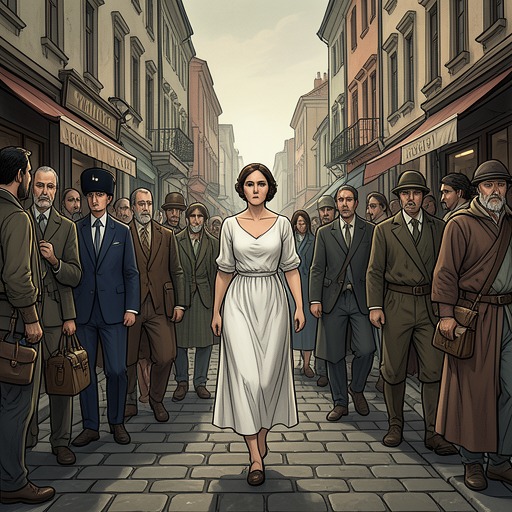
Marie-Laure's first walk onto the beach at Saint-Malo
All the Light We Cannot SeeMarie-Laure's first walk onto the beach at Saint-Malo is a decisive encounter with a world she had lived near without understanding: the ocean is not an idea at the edge of her father’s model, but a vast place she can enter through sound, touch, and movement. Led beyond the city walls by Madame Manec, she crosses from anxious anticipation into direct experience, then returns to Etienne LeBlanc carrying shells, barnacles, and quartz in her pockets.
Circumstances and Departure
The walk takes place in late February, after Marie-Laure’s father has been missing for twenty-nine days. Madame Manec’s heavy footsteps climb the stairs to Marie-Laure’s room; outside Etienne LeBlanc’s study, his voice objects, but Madame Manec proceeds. She wakes Marie-Laure and tells her to bring her cane. The outing begins not as an announced expedition but as a quiet crossing of a boundary within the household: Marie-Laure dresses herself, while Madame Manec waits downstairs with a heel of bread, ties a scarf over her head, buttons her coat to the collar, and opens the front door.
The morning is rainy and calm. Marie-Laure pauses to listen, counting her heartbeat in a pattern of two, four, six, and eight. Madame Manec reassures her that few people are out and that they are doing nothing wrong. The gate creaks; then Madame Manec guides her down one step and straight along the street. The cane’s tip catches against the irregular cobbles, vibrating as it catches again. Rain patters on roofs, runs through channels, and gathers on Marie-Laure’s scarf; sound bounces between the high houses. Although she is moving through the city, she feels its streets as a maze, recalling the disorientation of her first hour there.
Beyond the City Walls
Ordinary neighborhood sounds punctuate the walk: someone shakes a duster from an upper window, and a cat mewls. Marie-Laure wonders what dangers are outside and what her father had been so anxious to protect her from. Madame Manec turns them twice, then steers left, away from the route Marie-Laure expects. The moss-furred city walls, which had seemed to continue unbroken beside them, open at a gateway. They pass out of Saint-Malo and descend stairs, with Madame Manec guiding each step.
The transition changes the scale of what Marie-Laure can perceive. The ocean is directly in front of her, close despite having been beyond the city’s enclosing walls. Its sucking, booming, splashing, and rumbling sounds open into a space unlike the bounded environments she knows: larger than the Jardin des Plantes, the Seine, or the grand galleries of the museum. The contrast is not simply between city and shore. Marie-Laure recognizes that she had not imagined the ocean properly or comprehended its scale, though it had been nearby all along.
Learning the Shore by Touch
Madame Manec explains that a distant caller is Monsieur Radom calling to his dog, then offers her arm and tells her to sit, remove her shoes, and roll up her sleeves. When Marie-Laure asks what to do, Madame Manec tells her simply to walk. The instruction leaves the discovery to her body rather than giving her a description in advance.
The ground presents itself in successive textures: cold, rounded pebbles, crackling weeds, then smooth, wet sand. Marie-Laure bends and spreads her fingers across it, finding a surface like cold silk. The beach holds small objects deposited by the sea—pebbles, shells, barnacles, and slips of wrack—and her fingers search among them. Rain touches the backs of her hands and neck; the sand draws heat from her fingertips and the soles of her feet. These contacts make the shore legible without reducing it to a map or explanation: she learns where she is by moving through it.
As she follows the tide line, at first almost crawling, a knot that has been inside her for months begins to loosen. She imagines the beach extending around the promontory and along the Breton coastline, with its capes, ruined batteries, and vine-choked ruins; she also imagines the walled city behind her, its ramparts and puzzle of streets. In this changed perspective, the city becomes as small as her father’s model. Yet the imagined landscape beyond the model matters most precisely because her father’s representation had not conveyed what surrounded it.
Return with the Sea’s Offerings
Marie-Laure hears gulls overhead and feels grains of sand grinding against one another in her fists. For three hours, her hands find a stranded jellyfish, an encrusted buoy, and a thousand polished stones. She wades into the water up to her knees, soaking the hem of her dress. No occupation soldier comes to arrest the pair, and no one speaks to them. The absence of interference allows the outing to unfold as a sustained act of exploration rather than a brief glimpse of the shore.
Madame Manec eventually leads Marie-Laure back to the house. Damp and dazzled, Marie-Laure climbs all five flights and knocks on Etienne LeBlanc’s study door. He tells her he had worried because they were gone a long time. She answers by emptying her pockets into a gift for him: shells, barnacles, cowries, and thirteen lumps of quartz still gritty with sand. Her return gives the outing a tangible ending, but not a return to her former understanding. The objects carry the beach into the house, while her walk has shown her that the world beyond the model is larger and more compelling than its representation.